Attribution breaks down when your model only understands digital touchpoints. MARC changes the...
Connecting Offline and Online: How MARC Tracks the Full Customer Journey
Most customer journeys don't start in a browser tab. They start at a desk, in a conference room, or at a kitchen table - exactly where a MARC brochure lands. The challenge has always been connecting that offline moment of attention to the rest of your digital funnel. Without that connection, direct mail is hard to measure, hard to optimize, and nearly impossible to credit inside multi-touch attribution.
MARC closes that gap. Because every brochure reports back engagement data, you can finally see how offline interactions influence online behavior, sales conversations, and closed-won revenue. This article walks through how MARC tracks the full customer journey from first open to signed contract.
Why Offline-to-Online Tracking Has Been So Difficult
Digital channels have a simple advantage: every interaction happens in a trackable environment. Cookies, pixels, and embedded scripts make it easy to log what happened and when. Traditional direct mail doesn't offer that luxury. At best, you know when something was delivered. What you don't know is:
- Who actually opened the piece
- How long they spent with it
- Whether it was shared with colleagues or family members
- What eventually pushed them to visit your website, book a demo, or talk to sales
That missing data creates silos. Your marketing automation platform sees only the digital part of the journey. Your CRM sees only the meetings and deals. Direct mail sits in the middle as a mysterious "offline touch" that everyone suspects is important but no one can quantify.
What MARC Captures at the Offline Moment
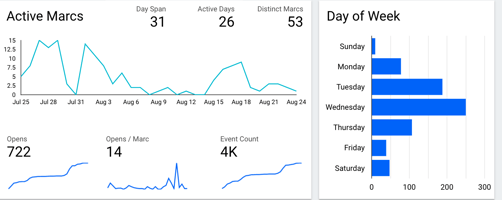
With MARC, the moment the brochure is opened, the journey becomes measurable. The analytics layer captures:
- First open - When the brochure is opened and the video begins.
- View duration - How long the recipient spent with the content.
- Replays - Whether they went back to re-watch, often a sign of higher interest.
- Multi-viewer activity - Engagement that indicates the brochure is being shared with other stakeholders.
- Multi-day engagement - When people come back to the brochure on different days.
- CTA interactions - QR scans, typed URLs, or other bridges into your digital experience.
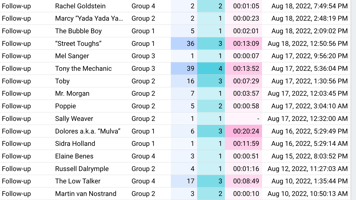
Each of these events is logged with a timestamp and tied to a specific brochure, which in turn is tied to a contact, account, or household. That's the first step in stitching offline and online together into a single story.
Connecting MARC Engagement to Your Digital Funnel
Once MARC engagement events are flowing into your systems, you can follow the thread from physical attention to digital action. A typical sequence looks like this:
- The prospect receives a MARC brochure and opens it.
- They watch 75 seconds of video and replay it once, triggering a "high-intent" engagement score.
- They scan the QR code, landing on a campaign-specific page or resource center.
- Your marketing automation platform logs the web visit and begins a nurture sequence tailored to that content.
- Your CRM updates the contact or account with a "High MARC Engagement" flag and notifies the assigned rep.
- The rep reaches out with context: "I saw you reviewed the [product/solution] overview - what stood out to you?"
Instead of looking at a web session in isolation, your team can see the full story: this prospect engaged deeply with a physical piece, shared it internally, then arrived on the site already familiar with your message.
Visualizing the Full Customer Journey
With MARC plugged into your CRM and analytics, journey reports start to look very different. Instead of chains of "ad > email > landing page > form fill," you start seeing patterns like:
- MARC open > 60+ second view > replay > web visit > demo request
- MARC open > multi-viewer activation > outbound call > opportunity creation
- MARC open > low initial engagement > second wave of digital nurture > replay weeks later > meeting booked
These sequences matter because they help you understand where MARC is strongest. For some segments, MARC is the first touch that warms up cold accounts. For others, it works best as a deal-acceleration piece that nudges stalled opportunities back into motion.
By layering MARC data alongside your digital engagement, you can also answer questions like:
- How much faster do deals move when MARC is part of the journey?
- Which audience segments respond most positively to physical outreach?
- How does MARC engagement change the conversion rate of later digital touches?
Practical Examples of Offline-Online Journeys
Account-Based Outreach
For account-based marketing, teams often start with targeted digital ads and outbound sequences. Adding MARC creates a new offline chapter:
A high-value account sees your ads and receives emails, but engagement is light. You send a MARC brochure to the buying committee. Several stakeholders watch the overview, replaying key sections on ROI and deployment. Within a week, web visits from that domain spike and multiple contacts engage with your pricing page. When sales reaches out, they're no longer starting cold - the account has already experienced your story in a tactile, memorable way.
Event Follow-Up
After a trade show or conference, follow-up emails compete with dozens of other vendors. A MARC brochure cuts through the noise. When someone opens it at their desk, MARC records the engagement and your system can trigger a personalized email referencing both the event and the brochure. If they click through to book time, your analytics show a clear link from physical follow-up to digital conversion.
See Your Own Offline-Online Journey in MARC Analytics
If you'd like to see how your customer journeys would look with MARC in the mix, the easiest next step is to walk through a live dashboard.
Schedule a MARC Analytics Demo
Or, if you prefer to start with a framework, you can pair this article with the multi-touch attribution template built specifically for MARC campaigns.
Download the Attribution Model Template