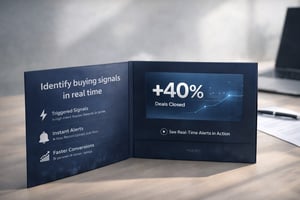
In sales, timing is often the difference between a polite decline and a booked meeting. The problem...
The Science of Direct Mail Timing: Real-Time Alerts and Sales Acceleration
Speed has become the competitive edge in modern B2B selling. Deals don't always go to the best product-they go to the company that engages at the right moment. Research from Gong, Salesforce, and Forrester repeatedly shows the same pattern: when sales teams time their outreach to coincide with buyer engagement, conversion rates rise dramatically.
Until MARC, that kind of precision timing simply wasn't possible in direct mail. Teams could send a high-value physical asset, but they had no visibility into when it was opened, whether it was watched, or when momentum inside the account spiked. Outreach became guesswork.
MARC introduces real-time alerts that transform how direct mail interacts with sales timing. Instead of waiting blindly for buyers to respond, sales teams can reach out at the exact moment interest appears-during the very minutes when buyers are most engaged.
This flagship article breaks down the science behind timing, how MARC alerts align with natural buying behaviors, and why timing-sensitive outreach driven by MARC consistently accelerates deals.
Why Timing Matters More Than Ever
In competitive markets, the window for meaningful engagement is narrow. Buyers research independently. They respond sporadically. They evaluate vendors asynchronously. In this environment, timing becomes a science rooted in behavioral cues rather than arbitrary quotas.
Digital channels offer some visibility-email opens, ad clicks, website visits-but these signals are fragmented and often unreliable. Direct mail historically offered none.
MARC closes that gap by revealing when buyers are active in real time-not days or weeks later.
The Problem With Traditional Direct Mail Timing
Before MARC analytics, sales teams were left to guess at timing. They relied on:
- Shipping confirmation dates
- Rough postal timelines
- Delayed responses (if any)
- Manual feedback from recipients
This created costly inefficiency:
- Reps followed up too soon, before the brochure was opened
- Or too late, after momentum was lost
- Or inconsistently, based on gut feel or rep preference
Without timing signals, even well-designed direct mail campaigns underperformed.
MARC Real-Time Alerts: The Breakthrough
MARC introduces real-time engagement alerts that notify sales teams when:
- A brochure is opened for the first time
- A buyer watches more than 30 or 60 seconds
- A replay occurs
- A new viewer engages
- An account shows multi-day engagement
- Engagement spikes ahead of scheduled meetings
These alerts transform direct mail from a static tactic into a dynamic sales-driver.
The Behavioral Science Behind Real-Time Timing
MARC alerts are powerful because they align with how buyers think and act. Engagement spikes reflect genuine cognitive focus, not passive interactions.
Three behavioral science principles explain why MARC timing works:
1. The "Attention Window" Effect
When someone opens a MARC brochure, they are in a state of heightened attention. Their mental context is aligned with your message. Reaching out during this window increases connection and relevance.
2. The "Information Freshness" Effect
Buyers are more receptive when your story is fresh. Outreach immediately after a replay or a second-day session leverages this freshness.
3. The "Momentum Cascade" Effect
When engagement spreads across viewers, it often precedes internal discussions. Reaching out during this cascade allows sales to join the conversation at its moment of formation.
How High-Performing Teams Use MARC Timing
1. Immediate Follow-Up on First Open
Sales reps receive an alert the moment the brochure is opened. The best teams send:
- A personalized email referencing the content
- Or a voicemail aligned with the video's storyline
- Or a LinkedIn message that continues the narrative
Response rates increase dramatically when outreach happens during or shortly after the viewing experience.
2. Triggering SDR Outreach on High-Intent Thresholds
When a buyer hits engagement thresholds like:
- 60 seconds watched
- 2+ replays
- Multi-day viewing
SDRs reach out with context:
"I noticed your team spent time exploring the ROI section-happy to walk through the numbers specific to your organization."
This message connects because it matches real behavior.
3. Surfacing Buying Committee Activation to AEs
When multi-viewer signals appear, AEs coordinate outreach to:
- Finance
- IT
- Procurement
- Department heads
Momentum inside the account is matched with momentum from the sales team.
4. Using Pre-Meeting Engagement to Adjust Demos
Pre-meeting engagement spikes show where interest or uncertainty lies. AEs adjust demos accordingly:
- Replay clustering around ROI - add financial modeling
- Technical replay - go deeper on architecture
- Customer story replay - emphasize use cases
This creates a tailored experience driven by empirical data.
The Funnel Acceleration Impact
Across MARC customers, timing-aware outreach consistently improves:
- Meeting conversion rates
- Opportunity creation
- Sales cycle length
- Close rates
One notable pattern: deals with early MARC engagement often move through the funnel faster because buyers enter conversations informed and aligned.
Integrating MARC Alerts Into RevOps Systems
Alerts become even more powerful when automated inside:
- Salesforce
- HubSpot
- Outreach
- Salesloft
- Marketo
RevOps teams build workflows such as:
- Notify AE when high-intent threshold is reached
- Add account to "active evaluation" list on multi-day engagement
- Trigger task for SDR when replay occurs
This creates operational rigor-timing becomes systematic, not improvisational.
See Real-Time Engagement Alerts Firsthand
We'll show you how MARC alerts align outreach with buyer behavior and accelerate deal cycles across your ABM and enterprise pipeline.