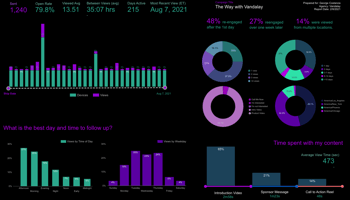
Marketers love dashboards—but only when the data inside them is actionable. One of the biggest...
The Direct Mail Engagement Curve: What MARC’s Analytics Reveal About Buyer Behavior
Direct mail has always been judged by blunt end results: responses, redemptions, calls, or form fills. What happens between the moment a prospect opens a physical piece and the moment they act - or don't - has largely been a mystery. That mystery has limited how marketers use direct mail, how they optimize it, and how they justify investing in it.
MARC changes that. By embedding analytics into each brochure, MARC reveals the full engagement curve of direct mail from the first open through multiple view sessions across days and decision makers. Instead of guessing whether a campaign is working, marketers finally see how buyers actually behave.
This flagship analysis walks through what MARC's data shows about the direct mail engagement curve, why it's fundamentally different from the way people interact with digital content, and how these insights translate into smarter strategy, better creative, and more revenue.
From "Did They Open It?" to a Complete Engagement Story
Traditional direct mail metrics answer only the final question: did something measurable happen? Coupon redeemed, phone call made, URL visited. Everything else, the emotional reaction, time spent, internal sharing, repeated reference, goes unrecorded.
MARC replaces that black box with a detailed engagement story. For every brochure, you can see:
- Whether it was opened and when
- How long it was watched in total
- How many distinct sessions occurred
- Which sections triggered replays
- Whether engagement spread across multiple days
- Whether multiple people viewed the same brochure
Across thousands of MARC campaigns, a clear pattern emerges: direct mail engagement does not behave like digital ad impressions or skimmable web pages. It behaves like something much more valuable - intentful, focused evaluation.
The Shape of the Direct Mail Engagement Curve
When you plot MARC engagement data over time, a characteristic curve appears. While every campaign has its own nuances, the same macro pattern consistently repeats:
- Initial curiosity spike: A high percentage of recipients open the brochure within the first 24-72 hours.
- Focused viewing window: Those who stay past the first few seconds often commit to watching a meaningful portion of the video.
- Replay and reference phase: A subset return to the brochure multiple times, rewatching key segments and sharing with others.
- Decision-support tail: Engagement tapers but does not disappear; buyers occasionally reopen the brochure as they move toward a decision.
Because MARC tracks each of these stages, you no longer see direct mail as a single "drop" followed by silence. You see it as a living, evolving interaction with your market.
Stage 1: The Curiosity Spike
MARC campaigns routinely achieve 80-90% open rates. That alone is a critical insight: when you send something tangible, people notice. Opening the brochure is not a casual thumb flick; it's an intentional act. Prospects set other things aside to see what this piece is about.
Unlike digital impressions where "viewability" can mean a fraction of a second of screen presence, an open event for a MARC brochure is a real moment of attention. It signals that the prospect has invested effort: they picked up the piece, opened it, and allowed the video to begin. The engagement curve starts from a higher-quality baseline.
Stage 2: The Focused Viewing Window
Once a MARC starts playing, the next critical threshold appears around the 8-12 second mark. MARC data shows that prospects make an early decision: either continue watching with intent or disengage.
For viewers who stay, average watch times range from 60-75 seconds of confirmed viewing. That is extraordinarily high compared to typical digital benchmarks, where many videos struggle to keep viewers for even 10-15 seconds.
This focused window is where narrative discipline matters. MARC data clearly shows that campaigns perform best when they:
- Establish relevance in the first 5-7 seconds
- Introduce a compelling problem or outcome quickly
- Use visuals that match the promise of the outer packaging
The engagement curve flattens, not plummets, when the opening seconds are clear, targeted, and anchored in the recipient's reality.
Stage 3: The Replay and Reference Phase
In digital, a replay is often accidental. With MARC, replays are intentional. They happen when someone wants to hear a specific point again, show a colleague, or compare what they just saw with something else they're evaluating.
Across MARC campaigns, 35-45% of engaged viewers trigger at least one replay. Many trigger more. Analytics often reveal two important patterns:
- Replay clusters around proof points: ROI examples, customer stories, and implementation explanations are replayed frequently.
- Replay timing maps to internal workflows: replays spike ahead of scheduled calls, internal meetings, or budget reviews.
The engagement curve in this phase tells you not just that someone is interested, but what specifically they care about - and when they care enough to revisit it.
Stage 4: The Decision-Support Tail
Even weeks after the initial mailing, MARC dashboards often show sporadic engagement from early recipients. A sales leader reopens the brochure before finalizing a contract. A CFO replays the ROI segment right before approving budget. A technical stakeholder watches the implementation overview again while drafting an internal recommendation.
In digital, this kind of "long tail" engagement is hard to ascribe to a specific asset. With MARC, it's clear: the same physical brochure continues to shape decisions far beyond the campaign's launch window.
What MARC's Data Reveals About Buyer Behavior
When you study engagement curves across industries and use cases, several consistent behavioral truths appear - insights you can only see because MARC measures what other direct mail cannot.
1. Buyers Give Physical Media the Benefit of the Doubt
High open rates and meaningful watch times tell a simple story: if you send something that feels valuable, people give it a chance. MARC's format leverages this effect. Recipients are more willing to allocate real attention to a premium brochure than to yet another email or banner ad - even if the message is similar.
2. Early Seconds Decide the Shape of the Curve
MARC engagement data shows a rapid divergence in curves based on how the first 10 seconds are used. Campaigns that lead with generic branding or internal jargon see steeper early drop-offs, while those that immediately address a specific business outcome retain significantly more viewers through the 30-60 second mark.
Because MARC surfaces these patterns, teams no longer debate creative direction based on taste. They debate based on observed behavior.
3. Replays Are Proxies for Internal Selling
Replays, especially when paired with multi-viewer signals, reliably indicate that an internal selling process has begun. A champion is showing others. A skeptical stakeholder is revisiting details. A decision maker is validating what they heard in a meeting.
For sales teams, this signal is gold. When replays cluster on certain segments, it often points directly to the topics that must be reinforced in follow-up conversations.
4. Multi-Viewer Activity Predicts Account-Level Momentum
MARC's ability to detect multi-viewer behavior reveals the unseen dynamics of buying committees. When the same brochure records engagement from multiple viewers, it is usually because it's being passed around inside a team, office, or household.
Accounts with multi-viewer behavior tend to generate more pipeline, higher deal values, and stronger close rates. The engagement curve effectively shifts upward for the entire account, not just a single contact.
5. Multi-Day Engagement Signals Serious Evaluation
Single-session engagement can indicate curiosity. Multi-day engagement almost always indicates evaluation. Prospects are fitting your story into their process, budget cycles, and internal priorities.
MARC makes this visible and quantifiable. Marketing and sales teams can define thresholds - such as “3+ days of engagement” - that automatically move contacts into higher-priority queues.
Turning Engagement Curves Into Strategy
Seeing the direct mail engagement curve is powerful, but the real value comes from acting on it. MARC customers use these analytics to shape strategy in four major ways.
1. Creative That Matches Real Attention Patterns
MARC data allows creative teams to design content around empirical attention curves instead of assumptions. This often leads to decisions like:
- Front-loading the most important proof points instead of delaying them
- Shortening intros and transitions to respect viewer time
- Using chapter-style structuring so buyers can quickly find what matters to them
Over time, engagement curves become smoother, with fewer early drop-offs and more sustained attention.
2. Lead Scoring Based on Real Behavior
Instead of relying solely on digital signals like email opens and ad clicks, marketing teams can incorporate MARC engagement into lead scoring models. For example:
- +20 points for 45+ seconds of watch time
- +30 points for replay behavior
- +35 points for multi-day engagement
- +40 points for multi-viewer activity
This makes the MQL definition more predictive and earns greater trust from sales teams.
3. Sales Timing Informed by Real-Time Alerts
MARC's real-time alerts align sales outreach with actual buyer behavior. Reps can be notified when:
- A prospect opens the brochure for the first time
- A high-intent threshold is crossed (for example, 60+ seconds watched)
- Replays spike at a specific account
Instead of “just checking in” at random, reps connect at the exact moment buyers are most engaged.
4. Campaign Optimization Using Benchmarks
By comparing their engagement curves with MARC's broader benchmark data, marketing teams can quickly identify underperforming campaigns. If your watch times, replays, or multi-day engagement significantly lag industry peers, you know to refine targeting, creative, or offers instead of guessing what went wrong.
From Guesswork to a Measurable Journey
The direct mail engagement curve was always there. Brochures were opened, watched, shared, revisited, and used in internal decisions long before MARC existed. The difference now is that you can see it - and act on it.
MARC doesn't just make direct mail measurable; it reveals a buyer behavior journey that digital-only analytics often miss. Prospects engage with a MARC brochure in ways that reflect serious, deliberate evaluation. Those behaviors are now visible, quantifiable, and directly connected to pipeline.
See Your Own Direct Mail Engagement Curve
Want to understand how your prospects really interact with your content? We'll deploy a MARC campaign, instrument it with analytics, and walk you through the engagement curve for your audience.