

Digital marketing teams rely on a sea of metrics-CTR, scroll depth, time on page, CAC, and more....
The New Attribution Layer: Connecting Offline Video Views to Funnel Velocity
Attribution has become the most misunderstood-and often the most overengineered-area of modern marketing. Teams layer together dashboards, models, pixels, and automation rules in an attempt to understand how prospects move from impression to opportunity. Yet for all the effort, one channel has remained stubbornly opaque: direct mail and physical engagement.
For years, marketers relied on rough proxies: unique URLs, QR codes, vanity phone numbers, or manual reporting from sales. None of these methods captured the nuance of what buyers actually did with a physical asset. None measured attention. None revealed how an offline touchpoint shaped internal conversations or influenced deal progression.
MARC changes the attribution landscape by introducing a measurable offline experience into a world dominated by online signals. For the first time, physical video brochures contribute directly to attribution data-down to the second, the replay, the session, and the multi-viewer interaction.
This flagship article explores how MARC creates a new attribution layer inside marketing and sales operations, why this layer captures intent more accurately than many digital signals, and how it accelerates funnel velocity across industries.
The Offline Blind Spot That MARC Finally Solves
Digital attribution is built on trackable clicks, form fills, views, and conversions. It's not perfect-far from it-but it gives teams directional clarity. Physical marketing, in contrast, has always been a guessing game.
Before MARC, direct mail could influence a seven-figure deal or play no role at all-and marketers had no way to prove either outcome with confidence. Instead, they were left relying on:
- Correlation instead of causation
- Anecdotal feedback from reps
- Self-reported "how did you hear about us?" responses
- Lagging indicators, like deals closing months later
The gap wasn't in creativity. It was in measurement. A brochure could captivate attention, circulate inside an account, and trigger internal alignment-but none of that behavior was visible. Direct mail remained the only channel operating in near-total darkness.
MARC introduces a breakthrough: direct visibility into buyer-level actions triggered by a physical asset.
The MARC Attribution Layer: What It Measures
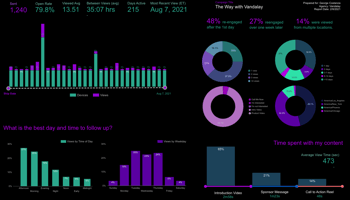
MARC analytics convert buyer behavior into measurable data signals. Each brochure tracks:
- Open events (who opened the brochure and when)
- Total view time and viewing depth
- Replays of specific segments
- Multi-session behavior (when buyers return)
- Multi-day engagement (a top predictor of evaluation)
- Multi-viewer activity within accounts
- Geo signals that confirm activation by target locations
From an attribution perspective, this becomes a goldmine. You no longer measure the impact of a physical touchpoint through indirect actions. You observe the actual behavior directly.
Why MARC Engagement Behaviors Are Stronger Intent Signals
Most attribution models mistake activity for intent. A website visit, a click on an email, or an ad impression can occur for dozens of reasons that have nothing to do with real commercial interest.
MARC signals, in contrast, are high-friction behaviors. They require time, attention, and internal interest. They correlate with intention because they are not accidental, impulsive, or algorithmically driven.
Across thousands of MARC campaigns, three offline behaviors consistently predict deal progression better than many digital actions:
1. Multi-Day Engagement
If prospects watch a brochure on multiple days, they're evaluating-not browsing.
2. Replay Behavior
Replays capture high-value scrutiny, often around ROI, proof points, and technical details.
3. Multi-Viewer Activity
This is the strongest indicator of buying committee activation. MARC is physically passed around the team. That behavior has no digital equivalent.
These signals are so strong that some marketing teams assign high-intent scores automatically based on MARC analytics alone-often outperforming third-party intent data.
How MARC Integrates Into Attribution Models
MARC acts as an attribution layer that fits into all major attribution frameworks:
1. First-Touch Attribution
When a MARC brochure is used as the first ABM touchpoint, open events and watch time become the first clear recorded engagement. This gives marketers visibility into early-stage influence that digital alone cannot replicate.
2. Multi-Touch Attribution
MARC provides pipeline influence data that can be weighted alongside digital channels. A standard model often includes:
- 25% pre-MARC engagement
- 50% MARC-driven activation
- 25% post-MARC touches
The true weighting depends on the length of the buying cycle and whether MARC was used early or late in the journey.
3. Last-Touch Attribution
Surprisingly often, MARC engagement spikes appear directly before a demo request or contract meeting. MARC becomes the last meaningful touchpoint before conversion, replacing what might otherwise be a forgettable email or an organic search click.
4. Custom Weighted Attribution
Many teams build custom attribution logic around MARC when using it for:
- Executive outreach
- Competitive displacement
- Renewal saves
- Expansion opportunities
Because the engagement signals are so clean, attribution distribution becomes easier to justify in reporting.
Why Offline-to-Online Attribution Has Been Broken Until Now
The core problem in offline attribution has always been visibility. Even when QR codes or unique URLs were used, marketers could only measure the sliver of buyers who scanned or clicked.
But most buyers internalize physical content without performing trackable online actions. With MARC, you capture:
- time spent
- internal sharing
- behavior before digital actions
- behavior instead of digital actions
It means you can finally measure the part of the journey that digital analytics cannot see-the offline moment where decisions begin forming.
The Funnel Velocity Effect: How MARC Accelerates Deals
Attribution is valuable not because it explains the past, but because it predicts and accelerates the future. MARC impacts funnel velocity in several measurable ways.
1. Better-Qualified Opportunities Enter the Funnel
MARC-engaged accounts typically demonstrate:
- Higher intent
- More internal alignment
- More informed stakeholders
These accounts convert at higher rates after initial contact, reducing early-stage drop-off.
2. Sales Conversations Start at a Higher Level
Instead of spending time explaining foundational concepts, reps jump directly into high-value discussions. This shortens:
- Discovery
- Solution mapping
- Budget validation
3. MARC Creates Momentum Inside Accounts
Multi-viewer engagement becomes a catalyst. Champions share the brochure to build consensus-an action no digital asset reliably inspires.
4. Real-Time Engagement Alerts Enable Perfect Timing
If a stakeholder reopens the brochure hours before a scheduled meeting, sales can fine-tune their approach in real time.
Across industries, MARC consistently reduces sales cycles by meaningful percentages-sometimes dramatically, especially in six-figure and seven-figure deals.
How Marketing Teams Use MARC Attribution in Reporting
Marketing leaders incorporate MARC attribution into reporting across:
- Quarterly business reviews
- Pipeline committees
- Revenue operations dashboards
- Executive scorecards
Typical reporting segments include:
- Accounts influenced by MARC
- Accounts activated by MARC (multi-viewer or multi-day)
- Opportunities created post-engagement
- Deals accelerated after high-intent viewing
Because MARC provides clear behavioral evidence, attribution discussions become far less subjective.
See MARC Attribution in Action
We'll walk you through a real engagement dashboard and show how MARC connects offline interactions to pipeline movement.